
The OakFood Project comes to an end
- OakFood

- Nov 28, 2025
- 3 min read
Updated: Dec 9, 2025
Portugal is an exceptional producer of acorns, due to its extensive montado ecosystem, with trees of the Quercus genus representing around 36% of the national forest area. Despite historical records of acorn consumption worldwide, and contemporary evidence of traditional consumption in some Portuguese regions, only the holm oak acorn (Quercus rotundifolia) is currently authorised for human consumption by the European Food Safety Authority (EFSA).
The OakFood project focused on the integrated valorisation of acorns as a Portuguese raw material for the development of value-added food products, as sustainable and short supply-chain alternatives for the food industry. The consortium, led by Food4Sustainability CoLAB (F4S), included seven agri-food companies (LandraTech, Arcadia International, Equanto, Pepe Aromas, Javalimágico, AgroGrIN Tech and Purenut), as well as the Portuguese Catholic University of Porto (CBQF-UCP), the Centre Regional Coordination and Development Commission of the Centre Region (CCDRC), representing the Viseu Innovation Hub, the National Confederation of Agriculture (CNA) and the National Competence Centre for Nuts (CNCFS), with national support from Mendes Gonçalves and transnational cooperation with the Spanish company BlendHub.
The main results obtained by the OakFood project were:
(1) development of a national production network for cork oak, oak and holm oak acorns, through the dissemination of a survey addressed to producers, followed by data analysis and the publication of a database, map and key results on the project website - https://www.food4sustainability.org/pt/oakfood.
(2) study and optimisation of protocols, including scalability analysis, to unlock continuous supply capacity to industry, and standardisation of all stages of the value chain, from harvesting to processing and transformation, ensuring that the acorns delivered to the food industry are of the highest possible quality. Compilation of comparative data collected by producers into a Producer Support Guide, presented at the 2025 National Agriculture Fair. In parallel, techniques for oil and starch extraction from acorns were optimised, and a technical baseline design was developed to support those wishing to start or professionalise acorn-based businesses.
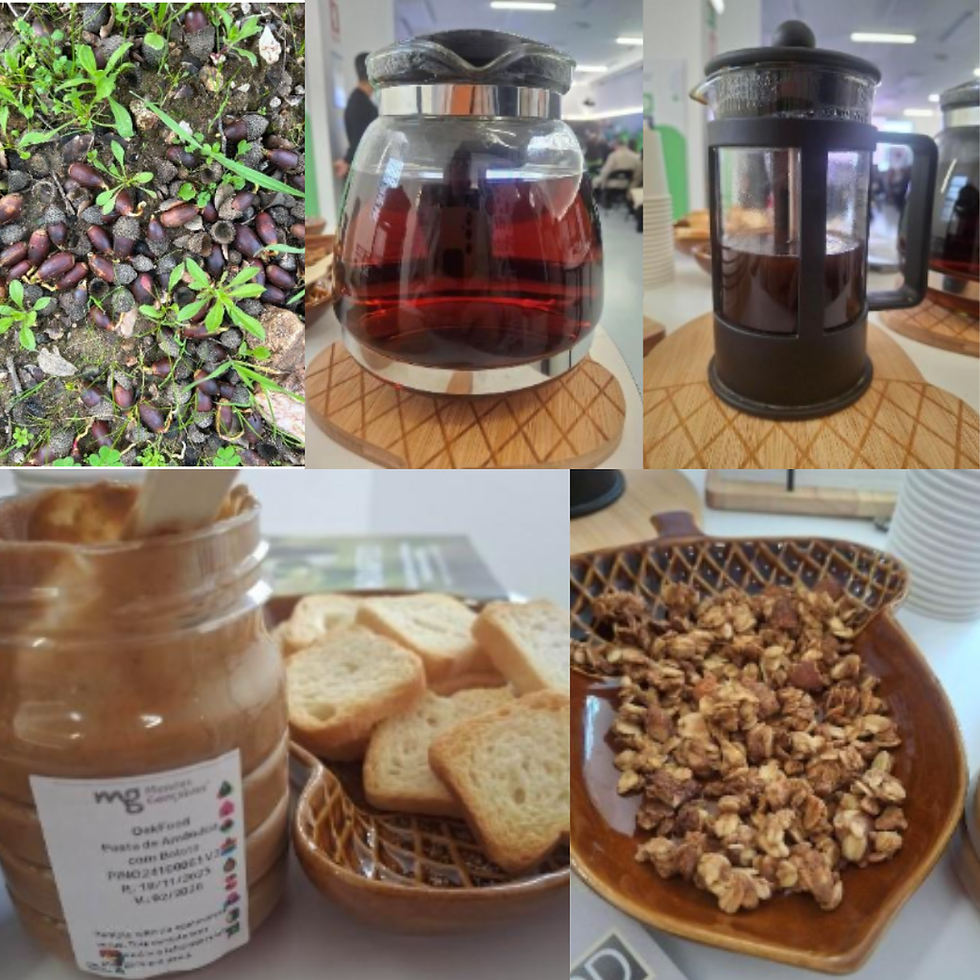
(3) development of ten innovative food products with export potential, incorporating acorn-derived ingredients for the production of flour, granolas, spreads, herbal infusions, coffee substitutes, roasted and ground acorn mixtures, protein, starch, craft beer and acorn biscuits. These products combine an interesting nutritional profile – rich in fibre, protein and bioactive compounds, with antioxidant potential – with strong roots in the Mediterranean diet and Portuguese food identity, increasing the commercial value of this raw material and encouraging its consumption.
(4) preparation of technical dossiers with the objective of obtaining authorisation for the human consumption of cork oak and oak acorns. This work is particularly relevant because, of the hundreds of acorn species referred to in scientific publications, only two species are currently listed in the European Union Novel Food Catalogue: the holm oak acorn (Quercus rotundifolia Lam), which can be used in human food, and the common oak acorn (Quercus robur L), which can only be used in food supplements. By working towards authorisation for other species, such as cork oak and oak, OakFood promotes the valorisation of the agricultural, forestry and food sectors in the covered territories, linking natural resource wealth to economic value creation and job generation, and strengthening the development of rural communities in inland regions, thereby fostering territorial cohesion.
(5) creation of a marketing and communication strategy focused on emerging national and international markets, supported by an assessment of the social, economic and environmental impact of the value chain under development.

(6) Communication and dissemination of the project through participation in 30 events, including fairs, congresses and conferences. Organisation of capacity-building actions for producers and awareness-raising initiatives (including gastronomic demonstrations) for the general public, with the aim of promoting the nutritional and environmental importance of acorns as a Portuguese ingredient.
OakFood comes to an end with the certainty that acorns can be much more than a forgotten by-product on the forest floor. The project ends, but leaves behind a more structured network, consolidated knowledge and new products that demonstrate how acorns can contribute to a more sustainable, healthy and truly Portuguese food system.
Useful links:
A redescoberta das bolotas para alimentação humana (2025), por Ana Oliveira e Inês Ferreira, iAlimentar
Bolota já não é só alimento animal, serve para fazer gelado, café e bolachas (2025), Notícias Magazine, Jornal de Notícias
Prémio Empreendedorismo e Inovação Crédito Agrícola (2024), Agroportal


Comments